
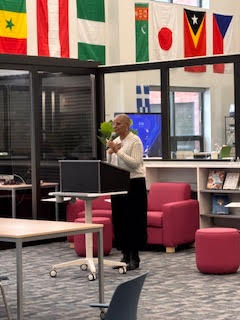




In a speech about civic engagement delivered to Middletown High School students, Connecticut’s Secretary of State as of 2022 Stephanie Thomas encouraged young adults and students alike to involve themselves more heavily in government and advocacy. “I try to travel around and talk to everyone, and I love talking to students, because hopefully you’ll get something out of this.” Thomas said, “Each of us, no matter what age you are, have the power to work through government, for or against laws, . . . we all have that power to help create policies that reflect our values.” Thomas’s delivery was confident and welcoming, yet firm and encouraging. She easily developed an encouraging environment by sparking participation and engagement from her audience through questions and mini verbal quizzes.
Highlighting the importance and involvement of government in our lives, Thomas shared an anecdote from her own childhood. “Before I was born, someone in my town decided, we will build affordable housing in the downtown area.” She then commented on the true impact and importance of this seemingly small policy change, as having more affordable housing opened the doors for her to not only be able to accept a scholarship to New York University but also commute to college while living at home. “If someone before I was born had not allowed that housing to be built, and that has shaped my entire life,” Thomas said, “that one elected person’s decision, . . . we don’t think about how long the effects are of laws that are passed every single day.”
She also detailed another law passed in recent years that granted free community college for all Connecticut residents and the understated impact it has had on young adults and their families. “Being able to go [to college], that impacts their entire lives in children’s lives, and on and on, I think about all the money that parents save, not having to pay for that college, that impacts their lives forever and ever.”
Thomas connected with students to encourage them to involve themselves in government, despite stereotypes that discourage young people from making change that impacts the world through government. She told the story of a 22 year old man who ran for the state senate and beat someone who had held the position for 22 years and went on to make plans to reduce debt for young students facing financial hardship after college. “So it’s just a really good example of one, a young person having an opinion and getting a seat at the table, but also casting a law and how these things impact us for a long time to come,” she said.
Thomas further explains the common misconceptions of civic duties for young people and how she herself experienced similar feelings in her teenage years. “It also wasn’t until I became elected myself, but I really thought about all the things that are our obligations to do in a democracy. I thought voting was enough.” She said, “And I think we’ve been conditioned in this country to think that our obligation is to vote, and that things just change, like, by magic, that the people we elected somehow know everything we want, they know everything we need, and they’ll just make it happen. But we do not live in a fairy tale. That is not how democracy works, that’s not ever how this worked.”
She continued on to explain that while representatives are elected in order to represent the people and their decisions, if people choose not to be civically involved, representatives just have to choose what they think would be best for the people, not the people themselves, which results in a disconnect between representatives and the people they’re representing. “No one in office knows everything about every subject,” Thomas said, “and sometimes we, the people, are the subject matter experts.”
However, she acknowledged that many young people feel that they are not educated enough to provide input for their government or frustrated that they’re unheard, making the situation more complex. Thomas said, “And frankly, I thought the same thing. I often thought, like, I’m not the expert, so no one’s gonna listen to me, or I don’t know enough about something. So why should I try?” She also admits that making strides in government is not a simple feat. In fact, it requires the work of many, many young individuals willing to put in work to make change. “When I think about all the big changes we had throughout history, whether it’s the civil rights movement, or women’s suffrage, or, you know, marriage equality, . . . no one just passed the law, and it all worked out.” Thomas said, “These are things that took decades of work and took many people, a lot of young people doing many different types of things to move the needle. And I think when you’re a teenager, it’s hard to wrap your head around how much government impacts everything in your life.”
On the contrary, Thomas dismantled this idea by stating that young people are actually the first group that the government looks to to inspire change and they often “wish more young people would participate,” according to Thomas. “We often say you have to be an expert to communicate with people in government,” She said, in reference to reaching out to your local officials about bills you’d like them to support or dismantle, “but you really just have to be you and have something to say.”
Thomas then recalled an instance in which a single email with “four exclamation points” caught her attention and, in turn, led her to propose a statement against the bill the sender was referring to. “It just happened to be a bill that I didn’t support, but I would have never known about it if that person hadn’t written it.” Thomas said, showing the importance of seemingly insignificant communications with government officials and their true ability to make change.
To conclude her speech, Thomas recollects the years upon years that it took to secure women’s right to vote through women’s suffrage, and leaves the audience with a question to consider: “So, this all took 80 years; and I often think to myself, Would it have been faster if more people had gotten involved? And I think the answer is yes.”
Thomas later delved further into what youth participation in civics and government really entails. In response to how advocacy should be made more accessible to young people, Thomas said, “There is no law that exists that says we have to teach people how to participate in our government. So as a result, there’s no office responsible for it. And there’s no money allocated to it. If that one thing changed, that would change.”
She also stated that ads, commercials, and other forms of media related to civic engagement being promoted would greatly improve the accessibility of advocacy and government engagement for young adults, all of which would require a greater budget and more defined requirements. She detailed the necessity of a voter guide in order to help educate young people about government and their opportunities and responsibility to be civically engaged. She then recalled that a plan in regards to a voter guide in an attempt to aid this issue was in action in Connecticut in recent years, but then “they never appropriated any money to it,” according to Thomas, hindering the plan’s success.
However, she continued to uphold that a voter guide would improve voter education, especially among young people, “And people participate when they feel knowledgeable about what they’re doing.” She said, “If they don’t know, they’re less likely to do it.” In a final message to young people looking to become more engaged in politics and government, Thomas said, “We need all voices, so please get involved . . . Don’t give up the fight before you actually try to fight it.”